Day 4 – Arron Provincial Park in Western Ontario

We head to our third provincial park here in Ontario. At first the sky is hazy filled with smoke from forest fires further north. We expect rain on and off today and get exactly that arriving at the Provincial park a couple of hours north and west of Thunder Bay. Despite the visibility we enjoy miles of views of Lake Superior which we’ve seen on and off over the past few days. In surface area Lake Superior is the world’s largest freshwater lake and contains 10% of the world’s surface freshwater. It’s hard to grasp but it is huge.

We pulled into the campground setting up is quick since we are not unhitching from the truck tonight. Tomorrow we should hit Manitoba. No photos for today.

June 23 – North Shore Lake Superior

Unlike yesterday where we pushed miles traveling over 400 today was an easy 250 miles as were are enjoying the Ontario Provincial Parks.

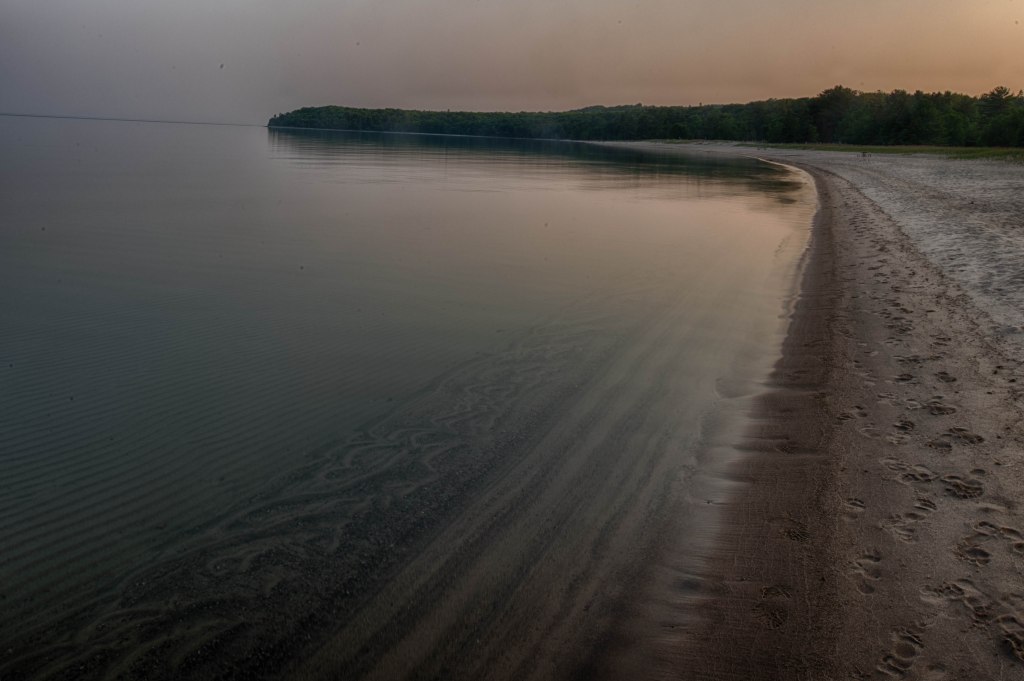
Must of the day various shorelines of Lake Superior were visible. There are forest fires well to our north in Ontario, so the visibility varied greatly throughout the day. At one point there was a freshly burned area that came to the one edge of the Trans Canada Highway. It did not jump the road. There is a outdoor fire burn in effect but we are still able to use our camper stove.

We pulled into our campsite midafternoon was a 1 minute walk to the lakeshore.

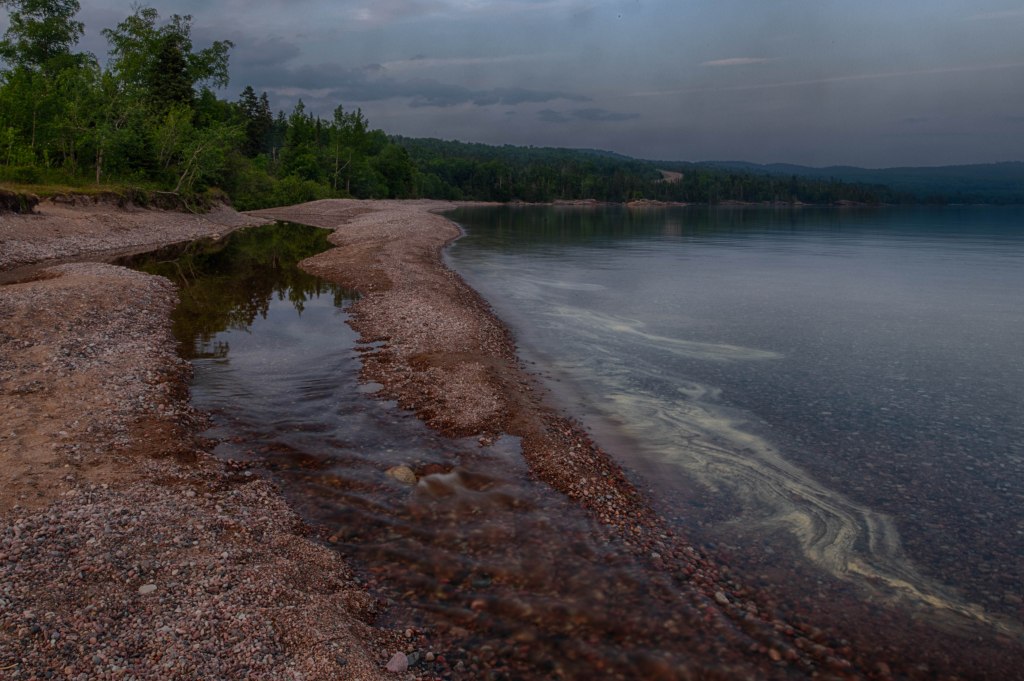
Along the shoreline at Rainbow Falls Provincial Park – Ontario

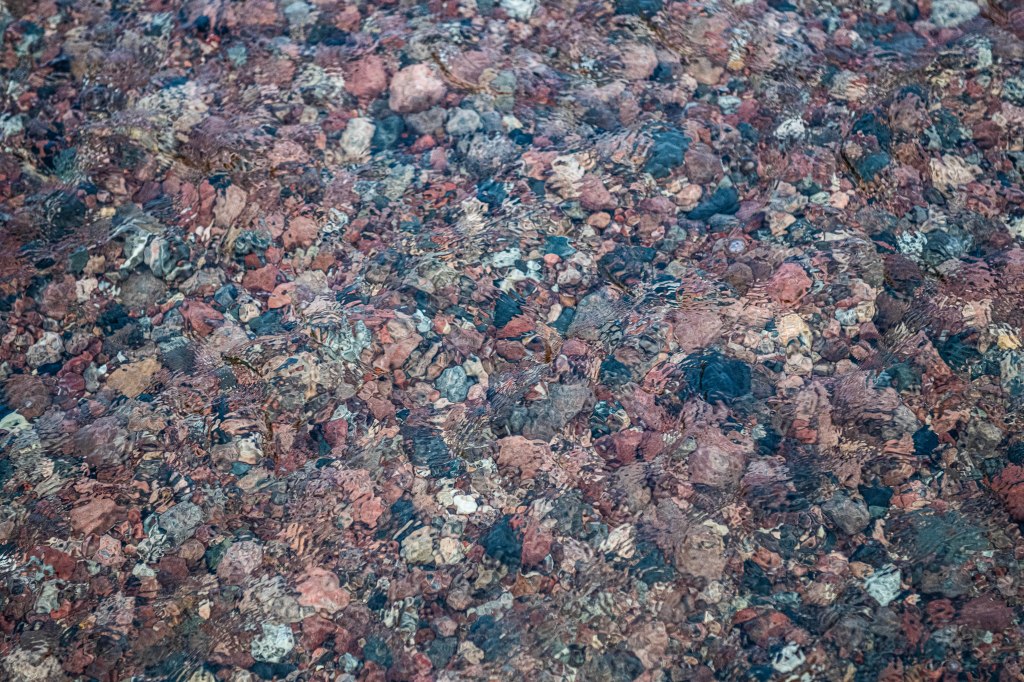
This is a shot of the bottom of the brook in the above photo.

June 21, 20023 – Day 1

Up until yesterday we had not even decided to start off west or north. We would head west if we could meet our friends in Wisconsin otherwise we considered head north and pass about all of the Great Lakes. We checked with our friends and then were not available when we would be passing through so on the Summer Solstice. We head towards the Thousand Islands Bridge and border crossing. We pull up to the immigration officer and he starts in with “Where are you heading?” I respond with, “Alaska”

He states, “You do know this is Canada, not Alaska.” It continued from there. It was maybe 5 minutes and we were through. We meandered west and north stopping for the night in Pembroke, Ontario.

Leading up to Traveling to Alaska

Heading out once again. We start the month of June with an eight day shake down trip with our trailer at=to Jamacia State Park in southern Vermont. Afterwards we are home for 2 ½ days then it’s off to Virginia where our daughter, Marni, is getting married. Once that celebration completes it’s back up to home where we are home for two days then it’s off once more. Our destination this time is Alaska with plans having us return sometime in October. Since, for us, it’s not the destination rather it’s the journey that’s important we’ll meander both out the heading out and return trips.

Fogo Island

Ever hear of Fogo Island? It’s the largest inhabited island near the coast of Newfoundland which itself is an island. The province joined Canada back in 1949 and was officially named Newfoundland. The actual land masses comprising the Province are the Newfoundland island and the larger area on the mainland called Labrador.  At one point the Province officially changed it’s name to Newfoundland and Labrador. My Canadian history is okay, yet it has many aspects where I can learn more. Oh, right, back to Fogo Island. It’s a fascinating transition that goes back not that many years. For many years the island supported several small fishing communities such as Fogo, Joe Batt’s Arm, Tilting, Seldom, and Deep Harbour. All these depended on the Cod fishing industry. In the early 1990’s the Government, in an effort to save the Cod, closed Cod fishing. There were no economic drivers for the Islanders to make a living. The entire island suffered. Many left, while others scrapped by on very little or attempted to make a living harvesting other seafood, or became dependent on Government payments.

Fast forward to 2006 when a highly successful Canadian businesswoman and social entrepreneur along with her brother created Shorefast, A not for profit business to invest in Fogo Island. Zita Cobb, born and raised on Fogo Island, grew up in a household without running water or electricity. The household income was from inshore Cod fishing. She left Fogo Island and went to business school in Ottawa and went on to have a highly successful career in the oil industry then in Fiber Optics. Her monies along with her brother’s pooled with contributions from both the Federal and Provincial Governments started Shorefast. Shorefast soon embarked on building the Fogo Island Inn, considered by many as a world class unique hotel. Between the employment and reinvestment of profits back into the Island the economic make up of the Island has vastly changed. In addition to the Fogo Island Inn, Shorefast has build four Artist Studio facilities scattered about the Island. Each of these facilities must be walked to via a trail since there are no roads to any of them. These spaces are designed to help encourage the creation of art and come with the use of a house (by a road) where the Artist lives while on the Island. The creation of the artist studios and the Inn have helped with transforming much of the Island to an economy based on tourism. The Inn employs over one hundred local residents plus much of the construction was locally sourced. The furnishing throughout the Inn were built by Islanders. Now due to inquiries from guests of the Inn about the furnishing there is a market for the furniture. With this basic structure in place a café opened and is now thriving. There’s an ice cream parlor, along with many more supporting businesses. Since the Inn opened around 2012 the Island has seen an economic turn-a-round.

With the revival there have been negatives impacting the Island as well. Cost of housing has skyrocketed due to the increase in outside (off Island) vacation home appeal. People from St. John’s or elsewhere such as Ontario are buying the homes. Even Zita Cobb has contributed to this by purchasing around 50 homes throughout the Island. 

That’s enough of a background on Fogo Island. We’ve been here before staying at the one RV Park on the Island run by the local Lions Club. The site has a spectacular view looking out over a large cove boxed in by two Heads. One of these, Brimstone Head, is somewhat of a northwest sentinel guarding the Island from the sea. Brimstone Head is also known at one of the four corners of the earth according to the Flat Earth Society. When we where here last the Flat Earth Society had a presence on the Island, however, the presence is no longer here. Maybe they fell off.

Fogo Island has many well-maintained hiking trails and it’s along these trails the Artist Studios stand. The artist residence where they live while on the Island are near the trail head. While out hiking on one of the trails we ran into the Island’s Mayor. A friendly and energic individual who was a wealth of knowledge concerning the Island. He spoke of the prosperity and growing pains the Island is experiencing along with likely solutions. For example, the one bank on  the Island abruptly closed down not long ago so the Mayor along with others are seeking an alternative which is looking like a Credit Union moving onto the Island. The Island has a small hospital/medical center, but at the moment does not have a Doctor. There is a scarcity of Medical Doctors throughout much of rural Canada. For Fogo, they have a prospective Doctor right now residing in Albany, NY who is from the US but her grandparents lived on Fogo Island so she wants to move to and practice on Fogo Island. The steps for that to happen take time and plenty of red tape. To hopefully speed things along, the Mayor is working with the Provinces Premiere.

Islanders are friendly and make it easy for people once they visit to want to come back again and again.
Further Wanderings

Here we’ll recap the past several days. After one more visit to the Puffin site we decide on our next area to explore. We hope to head to Cape St. Mary’s Ecological Reserve about 200 miles south of our current location. We have mixed feelings about this location which we’ve visited in a previous Newfoundland adventure. It’s one of six major North American Northern Gannett nesting sites. In normal years one can view tens of thousands of nesting pairs of Northern Gannetts, but this is not a normal year. Thinking back over the past few days we’ve observed many dead Common Murres floating in the ocean as well as washed up on the shore. The Common Murre and Northern Gannett have been decimated by the Avian Flu. On our boat trip looking for the Stellar’s Sea Eagle we’ve seen both species floating dead in the water.

The Northern Gannett colony has been hit extremely hard by the Avian Flu. Online photographs show the massive sea stack totally covered with nesting pairs earlier in the summer. Now, photographs show thousands of nesting pairs no longer living. Biologists now believe that it will not wipe out the colony, but will reduce the size for years to come.

This is our dilemma, travel the distance to see the devastation or bypass it for this year. We decide to see what the weather dictates since Cape St. Mary’s experiences heavy fog about 220 days each year. During these foggy periods visibility is reduced and it’s often hard to see the birds. A check of the forecast for the next several days revels rain and fog. This influences our decision so that we’ll visit St. John’s first then check the weather. We move to Butter Pot Provincial Park twenty miles outside the province’s largest city. We do a supply run then visit The Rooms, a major Newfoundland and Labrador museum dedicated to the cultural heritage and history of the Province.  It’s an impressive modern facility overlooking St. John’s Harbour.

On another day of wanderings we elect to explore the northern coastal area north of St. John’s. The coast views are dramatic and desolate sprinkled with many small coastal villages. These villages have quaint names including Harbour Grace, Bristol’s Hope, Heart’s Content, Heart’s Desire, Heart’s Delight, Hopeall, and Dildo, yes Dildo. All seem as if they could be names chosen by a marketing firm. Only Dildo uses the name for marketing and with impressive success. This is the home of the Dildo Brewing Company. We’ve visited here back in 2019 but found the brewery overwhelmed with tourists. Today we had hoped for a smaller crowd, but with no luck. The marketing phrase, already taken by Budweiser of “This Bud’s for You,” could be slightly changed for the Dildo Brewery to “This Beer’s for You.” Across the road is the Dildo Gift Shop so we wonder what sort of gifts do they sell?

The following day is a washout with plenty of rain continuing into the night. In the morning we find our trailer is three quarters surrounded by three inches of water. Our generator was stored under that back of the trailer and in the water. Pulling the generator out of the water we let it drain for a while then attempt to start it. It starts on the first pull. We avoid a disaster and count our good fortune. In checking the weather for the next couple of days and we see no improvement for Cape St. Mary’s. Our decision is made, we’ll leave here and start our trek west, but to where?

As we approach Gander we decide to head north to Fogo Island. Our next blog entry will start there.

Stellar!

We arrive at our campground in the early afternoon. This gives us the time to have lunch and set up the campsite. We are unhitched from the trailer and take the short the drive to Elliston where they call themselves the Root Cellar Capital of the World. Granted there are a ton of root cellars there, but our reason for going to Elliston is to view Puffins. We’ve been here before so we head to the parking area and walk the quarter mile or so to the of a narrow peninsular that ends with a 200 foot cliff to the ocean. 100 yards off the end of the peninsular is a sea stack/island that is covered with Puffins. These seabirds spend their entire lives at sea with the exception of breeding and raising of a single chick each year. They mate for life and each year come back to the same burro.

At this location, if people stay back from the edge and allow some room some puffins will come to our side. A few puffins came to our side and posed for a few photos. While there Wells meets another bird photographer and he mentions he was on a boat tour in the morning and viewed the Stellar’s Sea Eagle. In the last sentence we use the word “the” verses “a.” The eagle is the largest of all eagles maybe 3 to 5 pounds heavier than a Bald Eagle and is found in Japan and Asia’s east coast. This eagle has been sighted in various places first in Alaska then in Maine and Nova Scotia and then it disappeared. A couple of weeks ago a whale tour boat spotted the eagle but had no clue what it was. They took a photo and birders quickly identified it as a Stellar’s Sea Eagle. The tour boat operator started doing tours to see the bird. They saw it seven days in a row until today. They looked with 13 paying passengers onboard for 2 ½ hours. Fifteen minutes before giving up they spotted it.

We decide to attempt to sign up for the trip for tomorrow. Luckily there’s room and we show up early the next morning to the dock about 25 miles south of our campsite. We have 11 passengers split between serious birders and bird photographers. After two hours of searching with no luck other than repeating over and over, “Oh no, it’s just another bald eagle.” Then we see it, this majestic bird! It’s simply breathtaking.

Atlantic Puffin
Stellar’s Sea Eagle

We enjoy lunch at the Two Whales Café where we’ve eaten a few times in past years then back to the campground. Wells takes off to photograph puffins gain while Marsha enjoys some down time. Again, a few puffins cooperate and fly to our side.

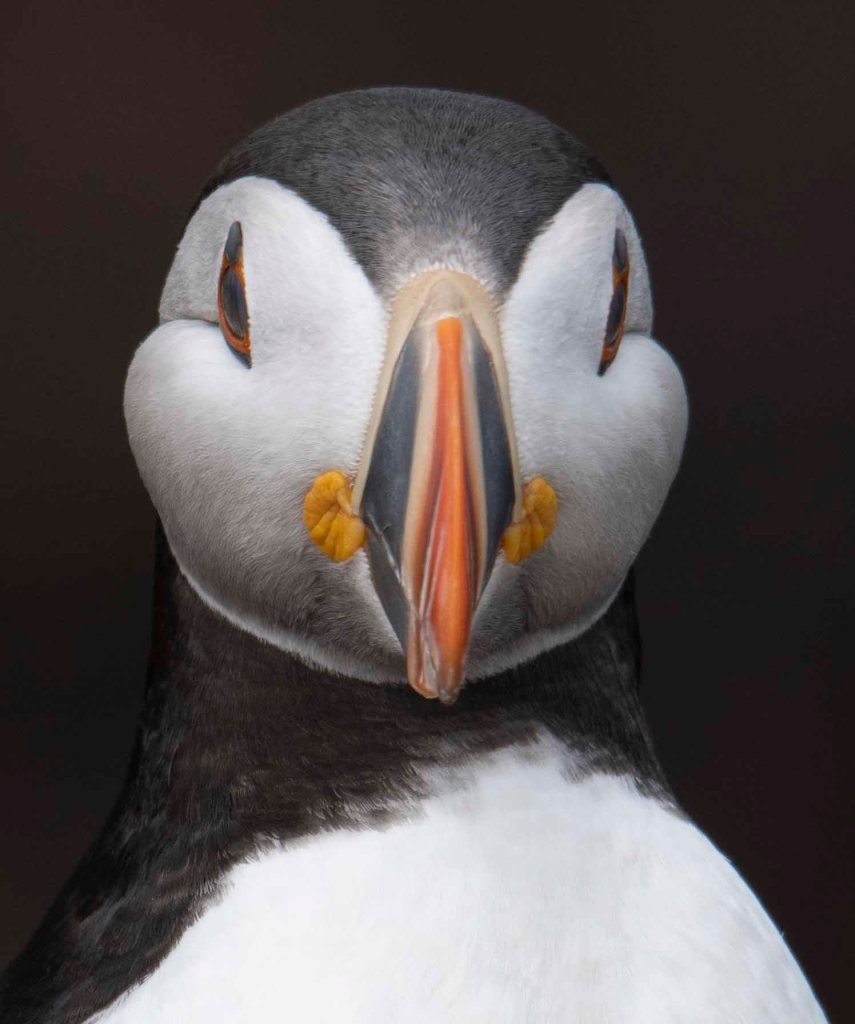
Are You Looking at Me

Newfoundland – Like a Lucky Nickel

We wake to rain, fog, and wind. We decided last night to do most of our outdoor packing before the wet weather hit so today we gradually prepare to head for the ferry in North Sydney to catch our 11:15 pm sailing. Loading of the ferry is a major operation trying to load maybe 300 or so cars, RVs, and tractor trailer trucks for the 7 ½ hour crossing. Our plan is to leave our campsite around 4 pm and drive the two hours to North Sydney. We’ll catch dinner in North Sydney and get to the loading area a bit after 7pm. You are required to be there between 2 to 4 hours prior to departure with loading beginning about 2 hours from departure.

We arrive near the ferry around 6 and begin our hunt for dinner. Parking is an issue for the truck/camper especially in crowded downtowns. We luck out as we find a Korean BBQ with nearby parking. We scored at this place with a great meal in a cozy environment.

Next, it’s on to the loading area. The order of which vehicles are loaded is orchestrated in a manor unknown to us, but makes sense to the ferry workers. Loading starts at 9 and our turn isn’t until well after 10:30. While we wait we play a few hands of cribbage then listen to a murder mystery book on tape. Once loaded we note our truck is on level 3. We head up to level 8 and grab a couple of chairs. Note to self, next time try booking a sleeping room. It was a less than restful night. We dock at 7:15 am which really is 7:45 am since we entered a new time zone. Newfoundland is one of those times zones where they are thirty minutes earlier than Atlantic Time.

Landing in Newfoundland we decide to push onward towards Stephenville before we grab breakfast or maybe brunch. Here is the former site of a US Air Force base. For those of you that know John Kirk the wonderful fiddle player this is where he was born.

After a late lunch we push onward to Barachois Pond Provincial Park just off the Trans Canada Highway. Any concerns about highway noise are totally gone since the park is down a narrow twisty road well away from any highway noise. We set up and prepare for a relaxing afternoon including a bit of napping when to our surprise Julie and David come riding by on their bikes. We keep running into them like a  lucky penny, but since here in Canada they no longer use pennies it’s more like a lucky nickel.