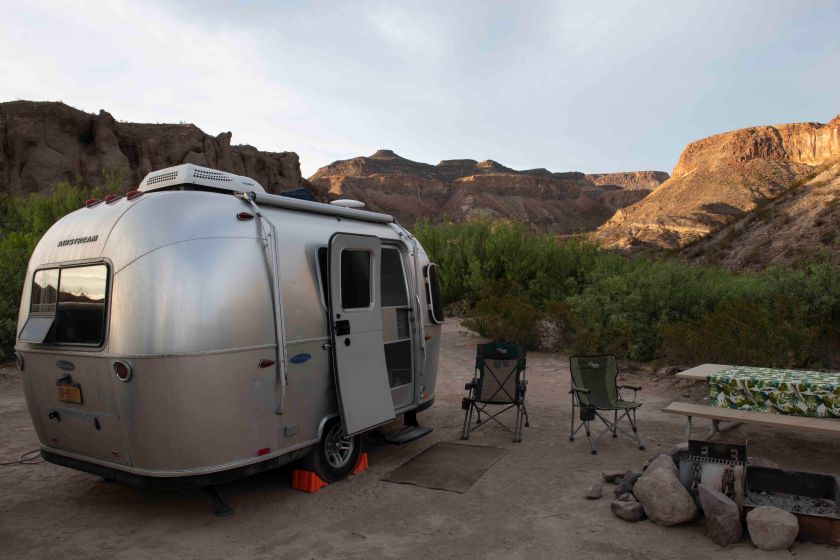
Saturday April 6 – City of Rocks

For those that can think back to the Flintstones and where they lived, Bedrock. It’s possible that the concept for Bedrock came from City of Rocks. City of Rocks is a New Mexico State Park where rocks are scattered and piled about. Anna arrives at our campground and the five of us, Anna, Scott, Dawn, Marsha, and Wells pile into one car and head northward to City of Rocks.

Best to show them in photos but we enjoyed exploring the rocks for hours. Once back at the campground we bid Anna goodbye. We hope are paths cross more in the future.

Once we all say goodbye to Anna, Wells gives his slideshow of last summer’s trip to Alaska. It was fun since Dawn and Scott were with us when some of the photographs were taken. If they were not with us they had traveled to many of the same locations.

We bid they goodbye and we head back to our trailer and enjoy leftovers from The Adobe Deli dinner we enjoyed last night. Tomorrow we meet up with our friend Lori.

Here are a couple more photos. The view from our campsite and a couple of Jackrabbits that are everywhere.

Friday April 5 – On to Deming

Overnight the temperature dropped to somewhere in the thirties. We know this since the inside trailer temperature a few minutes after Wells turned on the heat was a balmy 44 degrees. The inside temperature soon was in the sixties. Our destination for today has us arriving in Deming sometime between noon and one. Today we meet up with friends we met last summer in Alaska. Scott and Dawn live almost full-time in their camper and Anna lives in Deming. The five of us met last summer in Valdez, Alaska on the wildlife and glacier cruise the Lu Lu Belle.

So up and out of camp early as we enjoy the crisp mountain air. There are still patches of snow around since the elevation is well over 9,000 feet.  There’s a coyote slinking away from a road. Soon we are down the road and this is literal since the road descends over 4,000 feet in roughly 16 miles.

Las Cruses is the big city in these parts of New Mexico and over time the metro areas of Las Cruses and El Paso, Texas are merging as sprawl from both cities expand. The final leg of the day is along Interstate 10 for sixty miles to Deming. There is not much between these places once beyond the urban sprawl of Las Cruses. “Not much,” is a bit of an exaggeration. There is almost nothing.

Marsha sees an old highway on the map that gets us off the Interstate for the last 40 miles to Deming. Off in the distance one can see I 10 but our route is more enjoyable. We pull into Deming, grab some supplies and head out to our campground maybe a dozen miles outside of Deming. The road to our campground is flat and the last 7 miles are washboard gravel so it’s a slow go. The road ends at the Hidden Valley Ranch RV Resort. A sign at the beginning of the road to the place states Seven Miles on Gravel, but Worth it.

Dawn and Scott arrive while we check in and we quickly reconnect. We are chatting next to our truck at our campsite and a Desert Wren lands on a cactus 12 feet from us. Dawn says, “Wells, there’s your photo opportunity.” Since he’s next to the truck, he opens the door grab the camera and grabs the shot. Now he explains that the shot was taken after sitting in a bird blind for an hour before capturing the shot. Not really, but it makes a good story.
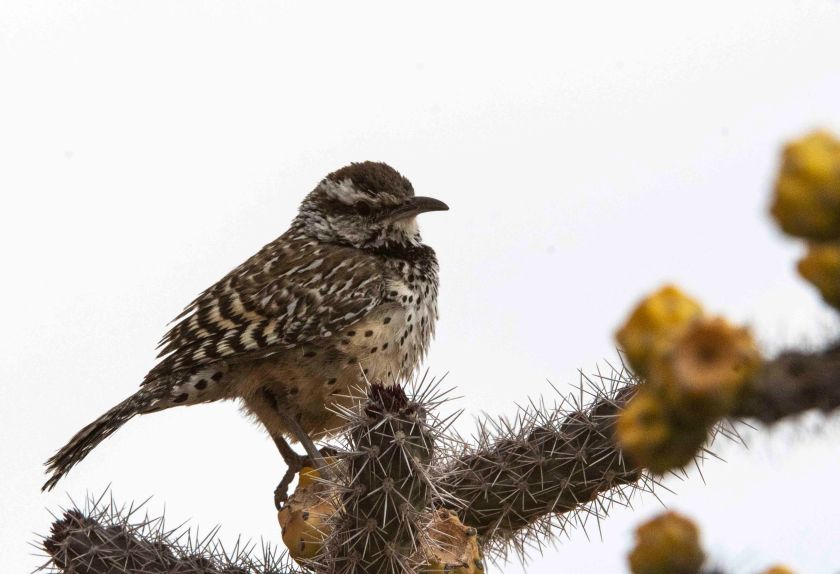
Bird on Cactus

The four of us pile into their car which they pull behind their Class A motorhome and head to town to meet up with Anna. From there we head out for dinner at the Adobe Bar out in the sticks. It’s an old school house converted into a restaurant and bar. It was great food and interesting atmosphere. After dinner Anna takes us back towards town where we stop at a winery.  Tomorrow Anna is taking us to the City of Rocks. Pulling into the campground we see a grey fox trotting off into the bush.

April 4 – Into New Mexico

Our goal for the day is to reach Cloudcroft, New Mexico high in the mountains well above 9,000 feet. The off-duty campground host at Fort Davis State Park recommended a few National Forest campgrounds outside of Cloudcroft.

Heading north from Fort Davis the road climbs slightly into flat dry desert. A lot like what we saw yesterday. Once we get north of Interstate 10 we get into oil boom country reminding us of traveling in western North Dakota last year on our way to Alaska. The oil boom here is considerably larger than western North Dakota. Soon we are passing pumping oil wells, pipeline construction along with construction and oil field related trucks. We pass many RV parks that are anything but recreation and parks. They house the oil field workers. It’s interesting to see the effect of the boom on the quality of life. Nowhere else on this trip have we seen much litter but here it lines the highways. One town even reminds us of Deadhorse up in Prudoe Bay on the shore of the Arctic Ocean. We do pass through a town that is thriving and does not appear to be decimated by the boom, Artesia. It has a delightful downtown.

At Artesia we turn west for roughly eighty miles to Cloudcroft. We head to the National Forest campground and find it closed along with the next 4 campgrounds. Once we find a place to turn around 7 miles down the road we head to town and find the National Forest Visitor Center where we find out these campgrounds open around April 19, but there is plenty of disbursed camping about 10 miles outside of town and that is where we are for the night now.


Wednesday April 3

After enjoying the quiet and beautiful campground all to ourselves we pack up. As we are packing Wells notices a small propane leak from one of our two propane tanks. The hose from the tank leaks if jostled so we turn the tank off. We still have one propane tank working fine and if it runs out of propane then we will just switch tanks. We need to replace the hose when we are in civilization.

We have the road to ourselves this morning probably traveling more than ten miles before we spy another vehicle.  As we round a bend in the road there are two Javelins. Okay, what the heck is a Javelin? Javelins look like a skinny pig but are not related to pigs. They are related to goats. While in the Big Bend area we’ve hoped to see them and today we do. Marsha is excited. She gets her goat!

We finally come to a small town and find a car wash! Our poor truck and camper are covered with dust so they finally have a shine. Next door is a hardware store but no luck with the propane hose. Looks as if we will need to find a RV Supply Store. We are not going to see anything today so Thursday or Friday we’ll find something.

The road turns northward from the Mexico as we head for a State Park in Fort Davis, TX. Once north of the Rio Grande we begin to see Pronghorn which is always exciting for us from the East. In Marfa while fueling a guy with his dog pulls in on his motorcycle. Yes, a dog is with him, goggles and all riding the sidecar. They are on an eleven month trip around the edge of the lower 48 States.  His blog is www.longmotoride.com

The dog with the aviator goggles is a hoot.

We arrive at the park to find it nearly full yet we get a spot. As we set up along comes a off duty campground host who has the exact same Bambi trailer as ours. She shares plenty of tips on modifications and Marsha is fully onboard. Next a couple pull into the site next to ours. The conversation with Wells goes something like, “So where’s home?” and the woman replies, “Florida. Where in New York are you?” and Wells replies, “Central New York State.” She replies, “Oh I’ve spent some time in Cooperstown, but I grew up on Long Island.” For Wells there is a vast difference between Long Island and Eastern Long Island where he grew up so he asks, “Where on Long Island?” and she responds with, “Way out East, Mattituck.” Mattituck and Cutchogue are next to each other. Now the two places are in the same school district, but when Wells was in high school they were not. She graduated in 1971 and Wells in 1970. A few of the high school girls Wells dated from Mattituck were friends of hers. It’s a small world.

Tuesday April 2 – Big Bend Ranch State Park

Today’s Plan – Do an easy hike this morning then hang out at our campsite in the afternoon. A mile down the road is the Hoodoo Trail which includes a lookout over the Rio Grande and down to the river’s edge. Birds are still difficult to pick out where they are singing away yet remain out of view in the sparse desert vegetation. We do see interesting birds including Vermilion Flychatcher, Black Phoebe, and Phryluxia. Naturally Wells is carrying his landscape lenses and not birding lenses. The Phryluxia was close and even posed but only for the camera of our eyes.

The Rio Grande is maybe a hundred feet across yet has some fast moving water. With a permit one can raft, kayak, or even tube on the river. On a day such as this with the temperatures in the eighties the idea of spending time on the river is enticing.

Campsite at Big Bend Ranch State Park

Midday we are back at the campsite for an afternoon of reading, napping, and puttering. A few items need some repair. Nothing drastic but with traveling the rough roads some things giggle loose so some work with a screw driver or wrench gets all back in order shortly. We both enjoy some reading time as well follow the shade around the trailer. First it’s the far side of the trailer and finally under our awning. We both explore the campground which today is empty other than us. Monday night there were four other campsites used but they all packed up and moved along. As evening rolls along the campground remains ours alone.

We have two camping nights before meeting up with Dawn and Scott in Deming, New Mexico. Plans are to spend Friday and Saturday nights a few miles outside of Deming then meet up with our friend who lives outside Silver City on Sunday.

Monday April 1 – Big Bend Ranch State Park

Monday April 1 – Big Bend Ranch State Park

After a good night sleep we wake up and decide to visit another Texas State Park, Big Bend Ranch just a few miles west of Big Bend National Park. It’s the least visited of all the Texas State Parks yet is one of the largest. Services are limited but at the visitor center we secure a site at a very small primitive campground. There are 6 campsites and a pit toilet. Each site is somewhat secluded with a picnic table. What else could we hope for now! Last night two sites were used but when arriving we find we are the only ones here. After setting up camp we leave the trailer and head out for a hike.

Getting to any trailhead involves driving. We pick one a Ranger recommends that is good for birding. It’s about a 20 mile drive on paved road then 21 miles of rough gravel road out of the Rio Grande Valley.  The hike starts in the desert and works its way up to a small canyon like area that has water and trees and birds. The trail apparently ends at a small falls and water pool but there’s little water flowing. We stop just short of the falls where the trail becomes a bit hairy knowing that there really aren’t falls to be seen.

Birds are plentiful but elusive to see. We get a view of a black chinned hummingbird. Wells first hears the hummer and wonders if in fact it was a hummingbird. After about 20 minutes we again hear the call and are lucky enough to gain a view of it. It’s fascinating that in this dry desert there are ecological oasis where available water creates a totally new environment.

We arrive at the truck and backtrack to the campsite where we are treated to more birds. Most views are fleeting but we see a pyrrhuloxia. What’s that? Basically you can call it a western cardinal.

Northern Parula 2

Sunday March 31 – Big Bend National Park

From the western edge of the National Park we head east to Rio Grande Village on the eastern edge. If you drive out of the park you can drive either west or north, but not east. Rio Grande Village is on a deadend road but there is access to Mexico if you check in at one point. It’s possible to get a boat ride across to Mexico but we elected not to do that excursion.

We found a common black hawk nesting site. With the birds not yet on their nest we do not see any common black hawks but we hear them. Next, we do a “Nature Trail” walk as Marsha continues to enjoy her busman’s holiday. The trail follows a peninsular sticking out due south where the Rio Grande does loop here. It has a wetlands area plus a climb to a viewpoint overlooking the Rio Grande. On the boardwalk over the wetlands we first view an American Coot. A Nutria revels itself and we get great views of this way overgrown muskrat like rodent. They are roughly the size of a good sized beaver yet with a large muskrat like tail.

After finishing this walk we pile into the truck and head for the Dagger Flats Auto Tour. Daggers are the flowering bloom of the Faxon Yucca Plant. Calling this an Auto Tour is a bit funny since it’s a rough unpaved road that goes in several miles to an area of many Yuccas. The road is rough and very narrow with few places to pull off to allow vehicles to pass.

Loggerhead shrikes and one golden eagle were some of our views along this route. Once again we stubble across another interesting location that few visitors of the park get to see. In the three hours we spend on the auto tour we encounter maybe ten vehicles.


Saturday March 30

Big Bend National Park is a special place. A place that we don’t want to be in the summer. This time of year is perfect to explore the Park. The spring bloom is bursting and one local told us it’s the best one in 30 years. Here the bluebonnets are not Texas Bluebonnets rather they are Big Bend Bluebonnets which are a bit taller than what we experienced in Texas Hill Country.

Arriving midday we discover the campgrounds are full so we head to the western edge of the park and find a campground two miles outside of the park. Leaving the trailer behind we head out to scout the park. It’s a vast desert area with a grouping of mountains in the middle. The Park’s southern edge is the Rio Grande River mostly running through deep canyons. The primary roads are paved yet there are several gravel roads for exploration depending upon your vehicle.  Most require 4 wheel drive and high clearance but not all.

One frustrating thing here in the park is we hear so many different birds in the varied habitats yet we seldom can see them. One of the predominate birds here other than the Turkey Vulture is the Northern Mockingibird.

Across from our campground is a small market so we head there not expecting much. Well to our surprise the market is well stocked with many items from organic veggies to Ben and Jerrys to seltzer water. We are happy campers. Tomorrow are plan is to bird more of the park.

Friday March 29

Our sights are set on Seminole Canyon State Park roughly halfway to Big Bend National Park. We skirt San Antonio as avoid as much of city congestion as we can and soon we are traveling through Texas Hill County. The further west and south we head the drier and flatter the land. Yuccas are more common many of which are in bloom. We called ahead to the State Park and they have “Primitive sites” available which translates to no water or electricity which is fine with us. It also could mean a parking lot or a beautiful location. It turns out to be a beautiful spot

Seminole Canyon site is roughly 3 miles from the Rio Grande and except for the canyon mostly flat. You can see for miles. Our site is beautiful with the view out over the canyon and many miles of desert beyond. It’s also windy.

Wells does a bit of bird photograph with a cooperative mockingbird. Well, maybe a tad too cooperative. The lens Wells is using is great for birds unless they get too close. The lens focuses only as close as 13 feet yet the bird comes and sits on a post less than 10 feet away!

We get a few chores completed and Wells plans an early photo shoot. Depends upon the lighting yet if you don’t try you are guaranteed not to get the shot. Tomorrow we’ll push south and west to Big Bend National Park.


Thursday March 28

Knowing from yesterday areas north and west of San Antonio the wildflowers have yet to bloom we decide to head east and south looking for the wildflowers. It did not take long to see Indian Paintbrush in bloom and a bit further on see the Bluebonnets.

Early afternoon we start northward to the Lady Bird Johnson National Wildflower Center on the southside of Austin. Lady Birth Johnson, married to Lyndon Johnson, was major advocate for preserving the natural beauty of the United States. Many consider her as the major influence for open spaces and preserving the natural beauty since Teddy Rooselvelt. She created the National Wildflower Center while in her 70s and it has thrived ever since.

While at the wildflower center an added treat was a view of a Great Horned Owl on her nest. This owl has nested at the entrance for the past 9 years.

Topping off the rest of the evening we visit with Marsha’s cousin Chip and his wife Dawn in Austin. It’s a short visit since the State Park entrance closes at 10. We have the pass code to unlock the gate but want to avoid the hassle and risk of it not working. We arrive back at the campground a bit before 10 PM and all is fine. Plans for tomorrow are to head westward.