Five Islands Provincial Park Travel Day

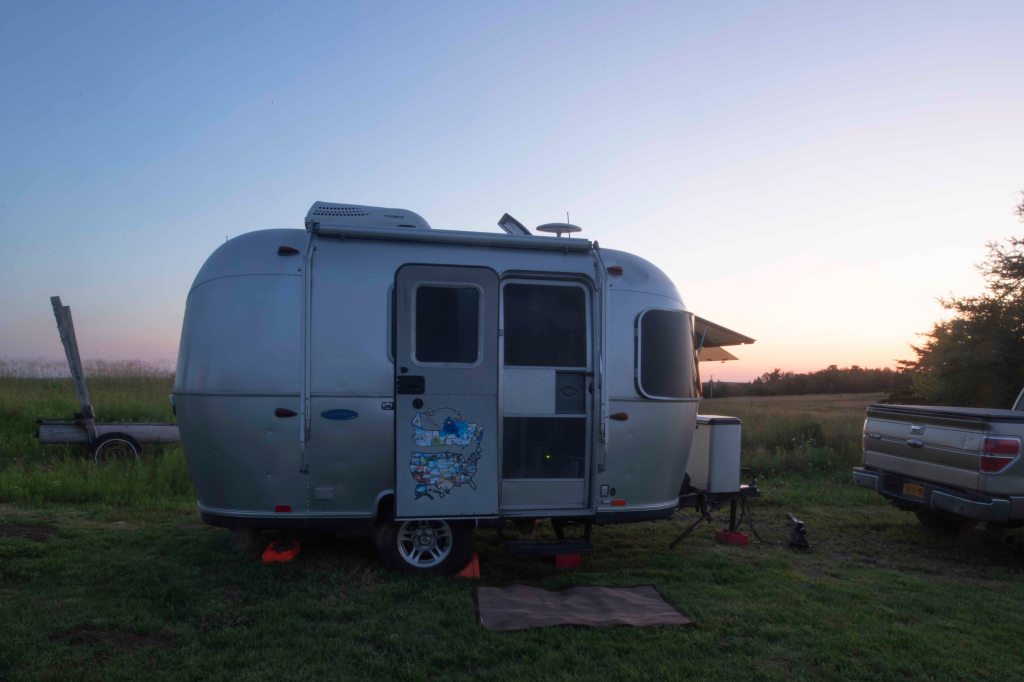
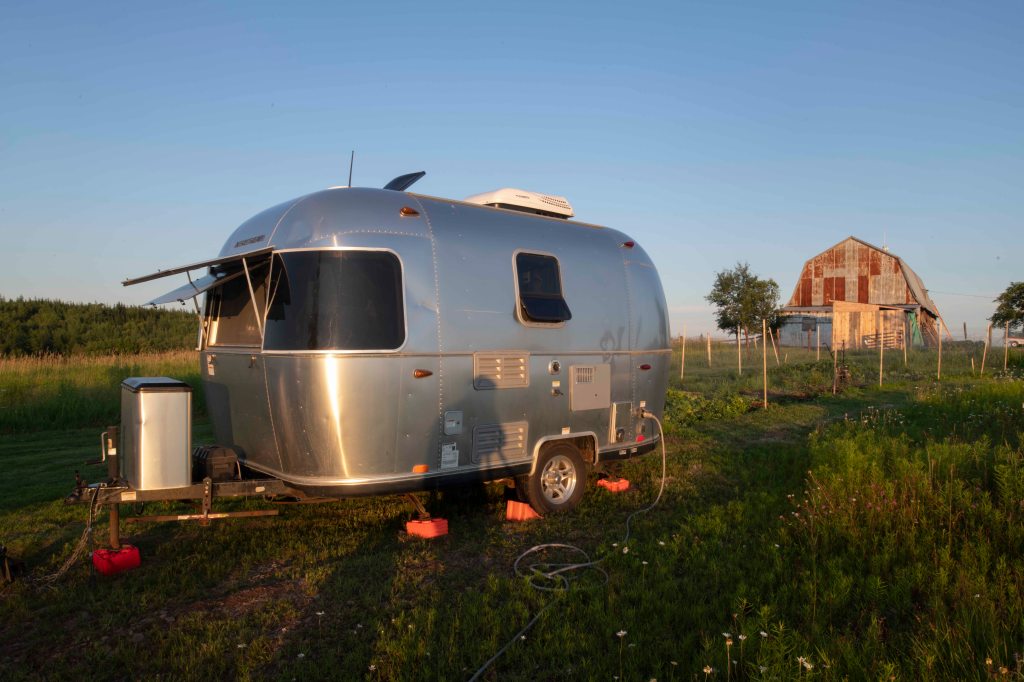
It needs to be stated that we travel most days, yet not all days are travel days. We call it a travel day when we hitch to our Airstream and move locations. We’ve enjoyed our stay at Valleyview Provincial Park overlooking the beautiful Annapolis Valley, a primary agricultural area of Nova Scotia, yet it’s time to move towards the far north reaches of the Bay of Fundy as our traveling companions, David and Jeanne start their trek towards home. Meanwhile, Marsha and Wells still have almost 3 weeks before we catch the ferry to Newfoundland.

Five Islands Provincial Park is part of the greater Fundy Geopark including much of the north shore of the Bay Fundy. Most of the campsites have views of the Bay and at times extensive mud flats depending upon the tide. We’re only here for one night yet there is plenty to see. Sunset has us along the shore as the four of us enjoy the sunset. Once the sun sets three are ready to head back to the campsites, but Wells encourages them to stick around. Once the sun sets then that is when the sky has the potential to put on a show. Well, the encouragement is not enough and we pile back into the one truck head back. About 30 minutes later the sky lights up.

The park has a 1 pm check out so we head out and explore a local area, Economy Cove. After there we head back to the campground to pack up and say our goodbyes. Next stop for Marsha and Wells is Nova Scotia’s North Shore near Pictou where the ferry runs from Nova Scotia to Prince Edward Island.

We are at the campground late afternoon and soon meet our new neighbors. They had no plans to spend the night here, rather their plans were to have taken the ferry over to PEI. The ferry just before their scheduled ferry caught fire. With roughly 200 passengers and crew plus 80 some odd vehicles onboard the ferry had an engine fire. All were evacuated onto fishing vessels. The passengers were not able to get anything out of their cars. The important thing is nobody was hurt. As I write this on Saturday evening the ferry is still offshore with all the cars still onboard. The ferry company has stated they do not yet know how much damage occurred to the vehicles or if they can be recovered. The fire continues to burn.
Annapolis – Royal – July 19

Steeped in history, Port Royal was an Acadian settlement established in 1605. In 1613 the site was destroyed by the British where the Acadians were deported to what is now the east coast of the US. In the 1930s the site was rebuilt from drawings made my Samuel Champlain, the French Explorer. The Acadians lived peaceful and traded with the local First Nations people, but it ended once the British burned the village.

Next, we traveled across the harbor to Annapolis and explored the British fort, Fort Ann. After another meal out we head back to our campsite.

Musee des Acadiens des Pubnicos – July 20

Today we head “West” towards the southern tip of Nova Scotia. Locally they say west, but we think that we are heading south. Today we are heading to Musee des Acadiens des Pubnicos in West Pubnico on one of the southern most points of Nova Scotia. This is a recreated Acadian village with village actors and interpreters. After the Acadian peoples were forced out of the Martine areas of New Brunswick, Nova Scotia, and Prince Edward Island and relocated to areas along what is now the east coast of the US. Note that were relocated to Protestant areas since they were Catholic. This happened prior to the founding of the US. Only afterwards did many migrate to the New Orleans area becoming what we now know of as Cajun. They were not moved directly from the Atlantic Provinces to southern Louisiana.

At some point Acadians attempted to return to Atlantic Canada. They were more welcomed back in the West Pubnico area often being able to secure the same land they once owned. Many other locations did not welcome them back as readily.

We spent three hours or so walking the grounds and enjoying the exhibits. The interpreters were most informative. The highlight for the day centered around the making of a couple of wooden wheels. The hub and spokes along with the wooden wheel rim were already completed. We witnessed the process of taking a iron rim, heating it in a fire to expand the ring then place it around the wooden wheel, hammering it into place, then pouring water on the finished wheel to cool it down and have the iron ring contract around the rest of the wheel. It’s an art and certainly not a science. The two wheels we witnessed were only the second and third wheels completed in the village. They were in the process of relearning the art of wheel building led by a skilled wheelwright.

After leaving there we headed toward Yarmouth and down to Cape Forchu. If you have ever traveled the ferry from Bar Harbor in Maine to Yarmouth, NS Cape Forchu is the first bit of land you pass by. We enjoy a few trails and ocean views. While walking the trails Wells decides to rest his right arm and hand and move his camera to his left hand. No risk of missing a shot since he did not expect anything to pop out of nowhere where he needed quick access to his camera. Boy, Wells was wrong. While walking along a trail a weasel popped out of the undercover ten feet away, looks at Wells and disappears into the understory.

Next is was into downtown Yarmouth, a town centered and focused fully on the port and waterfront. We enjoy another dinner then head back the hundred miles to our campground.

You Can See Whales in This? – July 18

We’re up and out early as we are headed to the Digby Neck for a whale watch trip on the Bay of Fundy. From the campsite to the dock, about an hour drive, it’s pea soup fog. Before venturing out on the whale watch we enjoy a breakfast at the café where the whale watch starts. There are three different whale watching companies sailing from Digby Neck. We are on the one where you don’t need to take a ferry. The Digby Neck is a very long finger of land that includes two long islands. To arrive at the end of the Neck requires two ferry rides. Our boat takes off from the very first ferry dock thus avoiding the ferries. The ferry pulls away from the dock and two minutes later we board the boat from the place vacated by the ferry.

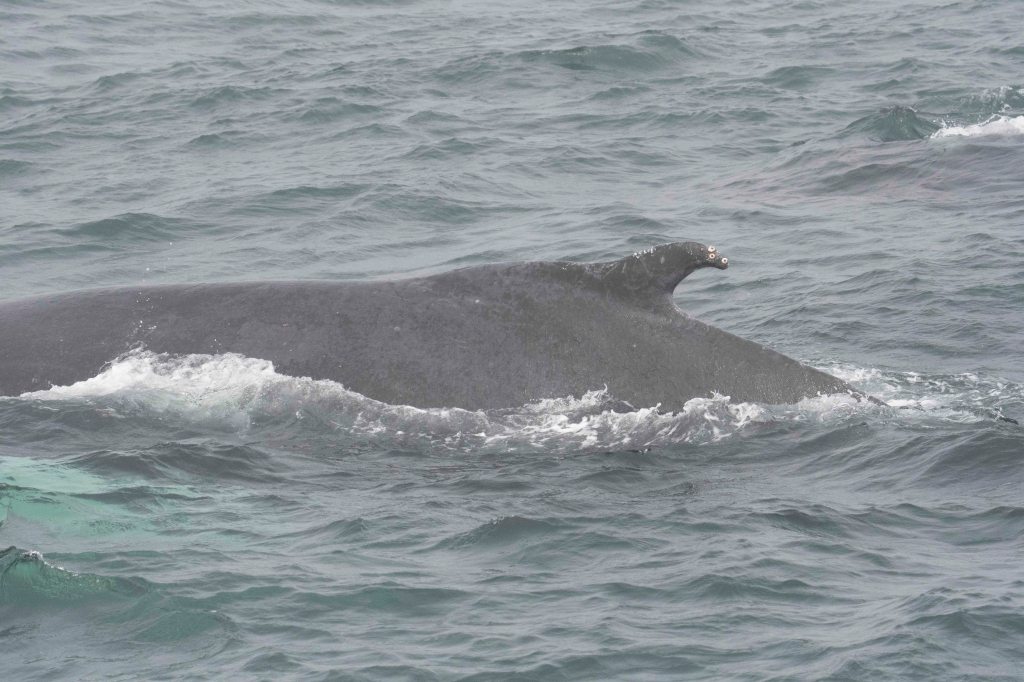
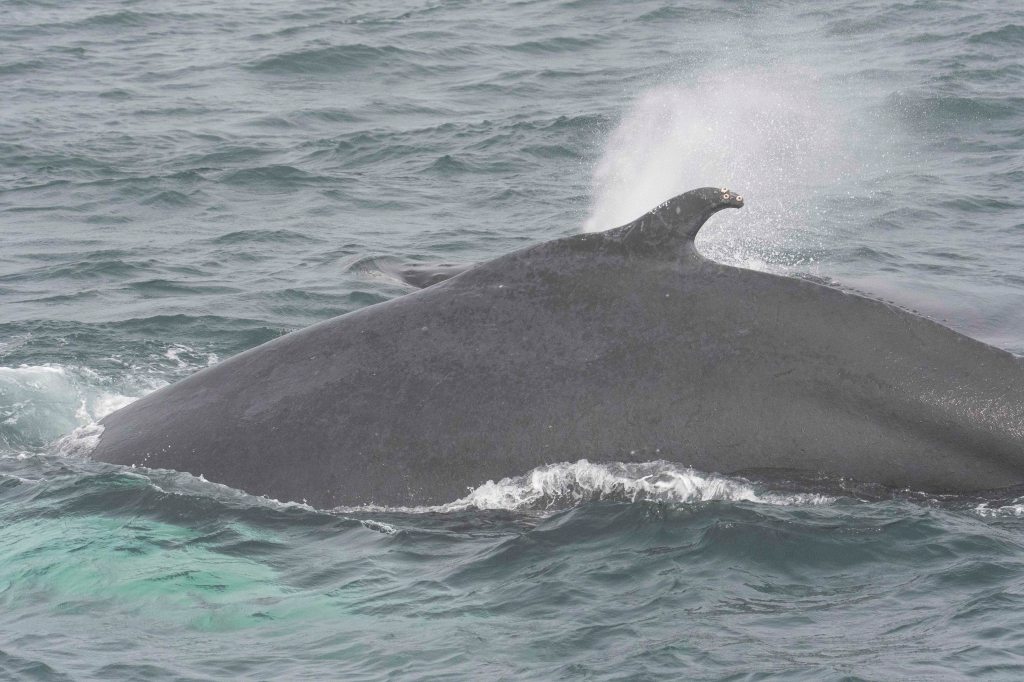
As we head out from the protected harbor, okay harbour, the fog does not abate. Spotting whales in this weather will be a challenge. Shortly after arriving in open water we spot an Ocean Sunfish or Mola Mola. These creatures weight up to 5,000 pounds and are huge. They are a boney fish that feeds on jellyfish and other small ocean critters. Locating whales in this thick soup is a challenge. All three whaling cruises head to the same general location and communicate with each other once whales are found. It’s hard to see any distance so it’s almost impossible to locate them that way. What they do is stop the boat and                      turn off the engines. Then it’s time to listen. They are listening for the sound the blowhole makes when the whale surfaces. Even hearing this sound in these windy conditions is tough. The process repeats several times with no luck. It’s time to turn around and head back to port when one of the other whale watching boats locates some humpbacks near our first listening spot while heading out. We return to there and have some up close views of three humpback whales, a mom, a calf, and an escort. This continues for roughly 20 minutes before we head back to the dock.

After grabbing a quick seafood lunch we head to the adorable small community of Bear River. Jeanne stumbled across a short write up on this artisan community so we were game. The road to this community was a rural country road, yet it was straight as an arrow with very uninteresting residences along the way. Wells remarked that what we were seeing at the moment was anything but interesting. The road was straight as an arrow over rolling hills. We came around the first bend in the road in maybe four miles when the character of everything changes as we come into the town. It’s on the Bear River and ships would travel up this narrow river from the Bay of Fundy as the tide rose and brought them to the community where there there’s a large area to turn around. They would dock at the shipping office building and unload and load cargo. When they were done they would return to the Bay of Fundy on an outgoing tide.

That shipping office building is now a two story art gallery where we made a few purchases and found out more about the town’s history. There’s another art gallery down the street which we also enjoyed. Once finished exploring we continued past the town center to a lovely small winery. Once done there we picked our way back home via smaller rural roads.

Lunenberg – July 16

Neither Marsha nor Wells were diligent in keeping the screen door closed the first night at the goat farm and we suffered for it. As the sun went down and the wind dropped the mosquitos decided our camper was a great refuge to rest then grab bites to drink all night. No matter how many times we were up with a fly swatter it was fruitless in ridding our sleeping quarters of the pests. It was not a great sleeping night. In the morning we hop into one of our trucks and the four of us take off for Lunenberg. Lunenberg is a world heritage site representing a port laid out by the British in the mid seventeen hundreds. It was a noted ship building hub. A replica of the Bluenose is docked there. The original ship symbolizes the importance of Nova Scotia’s ship building skills. It even was at the Chicago World Fair way back when. The town is built around the harbor or maybe I should say harbour since we are in Canada. It’s a major tourist center with restaurants, art galleries, and other shops. We enjoyed or half day in and about the town then back to the goat farm. Tonight we were much better about keep the screen door shut and slept well.

Leaving PEI onto Nova Scotia

Today’s a travel day with a goal of reaching our destination of a goat farm a few miles outside of Turo, Nova Scotia. As we cross the Confederation Bridge and pay our $55 toll we think back to the five days spend in Canada’s smallest Province. A toll is not collected on the way out to PEI, just when leaving the Island. There was still more to see and experience but we’ll save that for another time. Prince Edward, being Canada’s smallest Provide is larger in area than either Rhode Island or Delaware yet is dwarfed in size by the other 9 Provinces.  

At a stop along our route, we realize that if we hurry we could catch sight of the tidal bore in the upper reaches of the Bay of Fundy where tides can rise up to 50 feet twice each day. The tidal bore happens just after low tide were the water reverses flow starting with a wave of water. Three years ago in Moncton, New Brunswick Marsha and Wells witnessed two surfers surf the tidal bore traveling a few miles. It would be a pain if you missed that first wave since you would need to wait about 12 ½ hours for the next wave to come. We arrived about ten minutes too late to see the tidal bore this afternoon, but we’ll have a chance maybe tomorrow.

We arrived at this goat farm where there is room for two camping units to be overlooking miles of grazing land and forests. We are the only two campers here and we have a lovely stop.

PEI East End – July 14

Today the four of us pile into one truck and head towards the east end. We’ve explored the other Island areas so it’s time to head east. First stop is St. Peters with some craft shops and a large Catholic Church viewable from across the valley. The bay is filled with mussels being raised. In many of the Island bays and tidal estuaries there are either mussels or oysters being grown. Oysters are farmed in cages that float just below the water surface. Every so often the are flipped over or pulled out of the water for up to a full day. This somehow results in them growing faster. A farmed oyster can reach marketable size in three years while a wild oyster takes about six years. Mussels are farmed in vertical mesh bags hung from buoys.

Soon we find ourselves following the coast and the many tidal bays and inlets along the Island’s eastern shore. Lunch is another seafood feast. We notice some of the coastal harbor villages have deep water ports with some larger cargo type ships. As we round the southeastern corner of the Province we start our journey back to our campsite.

Dinner plans for tonight are to go to the Blue Mussel Café. It’s a very popular restaurant on the water in North Rustico near the primary tourist area of the Island. They don’t take reservations but they do have a wait list which one can sign up for online.  We get on the wait list but it’s not until 8 pm. Once there we wait 20 minutes for a table. The place is hopping loaded with patrons along with many employees. Here the employee’s work hard yet are highly attentive to the customer’s needs. It’s an impressive operation. And the food? Wells proclaims it’s one of the better meals he’s ever had. We enjoyed ourselves and made it back to the campground a bit after ten.

PEI West End and Cape North – July 13

Instead of taking the “big two lane road” we elect to take the coastal roads enjoying the back roads of PEI. We stop at an oyster packing house where Marsha and Wells had been to three years ago. There we purchased a box of oysters sorted and packed today. Into the cooler they go. Onward to Cape North where we enjoy the views, but no photographs. Even in a beautiful area such as this, photos can be boring if the right light is not present. Capturing special images is not done within a group, unless the group is of photographers. Both sightseeing and photography are fun but it’s tough doing both at the sametime.

Heading back towards the campground we make a couple of stops, first at farm stand and the second a seafood market. Dinner tonight stated with cheeses, dips, veggie sticks, and crackers. Second course, steamed oysters. Third course, steamed mussels. We ended the final course with sautéed scallops. We enjoyed our feast.